Quarry Hill
30 Community Drive • Camden, Maine • 04843 (207) 301-6100 • qhinfo@mainehealth.org

Easing Back into Post-Pandemic Life
Posted on Tuesday June 8
Back in April, just as most Americans were getting as giddy as kids in a candy shop over the prospect of a life post-COVID, we stumbled on an interesting article on thelily.com. In it, author Aviva Loeb said that despite the general merriment about once again being able to go out to eat, roam the aisles of grocery stores maskless, and, best of all, visit with friends and loved ones, some folks were experiencing “mixed emotions.”
Indeed, both here at Quarry Hill and amongst our friends and relatives elsewhere, we’ve found that some people are feeling a bit anxious about returning to normal. Some worry they’ve lost the art of casual chit-chat. Others fear it’s too soon to let down our guard. Seniors, particularly those in their 80s and 90s, question whether they have the stamina or even the desire to do what they did pre-pandemic.
Quarry Hill health services coordinator Nina Cunningham, RN, says some of Loeb’s advice for “easing back” into a more outgoing way of life may be especially useful for older adults and those trying to help them adjust.
For starters, Nina counsels elders who’ve been sick with COVID or suffered the loss of someone they love to “give yourself time to process what you’ve been through.” Journaling, walking or spending time outdoors, or talking with a trusted confidante or mental health provider can help bring closure and make it easier to carry on.
If you’re among the legions of introverts who have long appreciated periods of solitude, or if you found you liked the slower pace that resulted from COVID restrictions and cancellations, remember that you can keep whatever aspects of life under COVID you’ve liked. Do try to build some form of social engagement back into your life, because everyone needs at least a little in-person interaction for the sake of mental health. But be choosy. Pick only those activities or contacts you truly enjoy.
Finally, embrace your inner curmudgeon. Even if everyone around you is raving about the experiences they can’t wait to have this summer, it’s okay to take a more conservative approach. Plenty of people are still wearing masks inside grocery stores and saying “no thanks” to wedding invitations. They’re not wrong. In fact, they’re providing a public service by reminding the rest of us of the importance of remaining vigilant, lest current policy relaxations lead to new outbreaks.
We’ll have more on this topic in the next issue of Quarry Hill’s News & Views newsletter. In the meantime, please enjoy “easing back in”—in whatever ways and to whatever extent your comfort level allows.
Building Elders Defenses Against the COVID “Lonelys”
Posted on Thursday March 4
Today’s social scientists and healthcare providers call it social isolation. Older folks call it just plain lonely. But whatever terms you use, spending days or weeks on end with little meaningful interaction with others or with the world outside one’s own four walls has disproportionately afflicted people age 65 and up in our society. And the current pandemic has made a bad situation worse.
Physical distancing guidelines are, of course, essential, especially for seniors. But as the U.S. Centers for Disease Control, the National Institute on Aging, and other organizations have underscored, the resulting isolation significantly increases elders’ risk of everything from depression and anxiety to heart disease, high blood pressure, Alzheimer’s disease and even death.
The good news is, there’s plenty we all can do to help “inoculate” the older people we love against the ravages of chronic loneliness. Experts recommend making sure the senior in your life has at least these three things in place:
Alternative Ways to Socialize
Set them up with the technology they need for virtual visits with family and friends—and, if necessary, show them how to use it. Consider “Zooming” at the same time every week, or just checking in by phone at the same time every day, to give your loved one the added benefit of having something to look forward to. You can also help them find other safe ways to socialize online, like secure chatrooms, private Facebook groups, and internet game clubs.
Physical Activity
Nothing boosts a person’s mood like a little exercise. Encourage Mom or Dad to get outdoors every day, weather permitting, for a walk—even if it’s only to the corner stop sign and back. Help them find an appropriate fitness or stretching class online (YouTube has zillions). Or suggest they get up and dance a few times each day to whatever music they love.
Something to Think About
When it comes to keeping loneliness at bay, an active brain is almost as important as an active body. Mental stimulation can be as straightforward as reading a book or working a puzzle, or more ambitious, like learning a new language online. Explore options that match your family member’s interests, and do your best to get him or her involved.
In short, while it’s true that COVID safety will likely require older folks to practice physical isolation for a while longer, the harmful effects of social isolation can, through a combination of user-friendly tech and old-school creativity, be avoided. For a fuller treatment of this subject, check out the Winter-Spring 2021 edition of Quarry Hill’s News & Views newsletter, coming to subscribers’ mailboxes—and to our website—in April. Or link to the following trusted sources:
Living the Active Life
Posted on Friday January 24
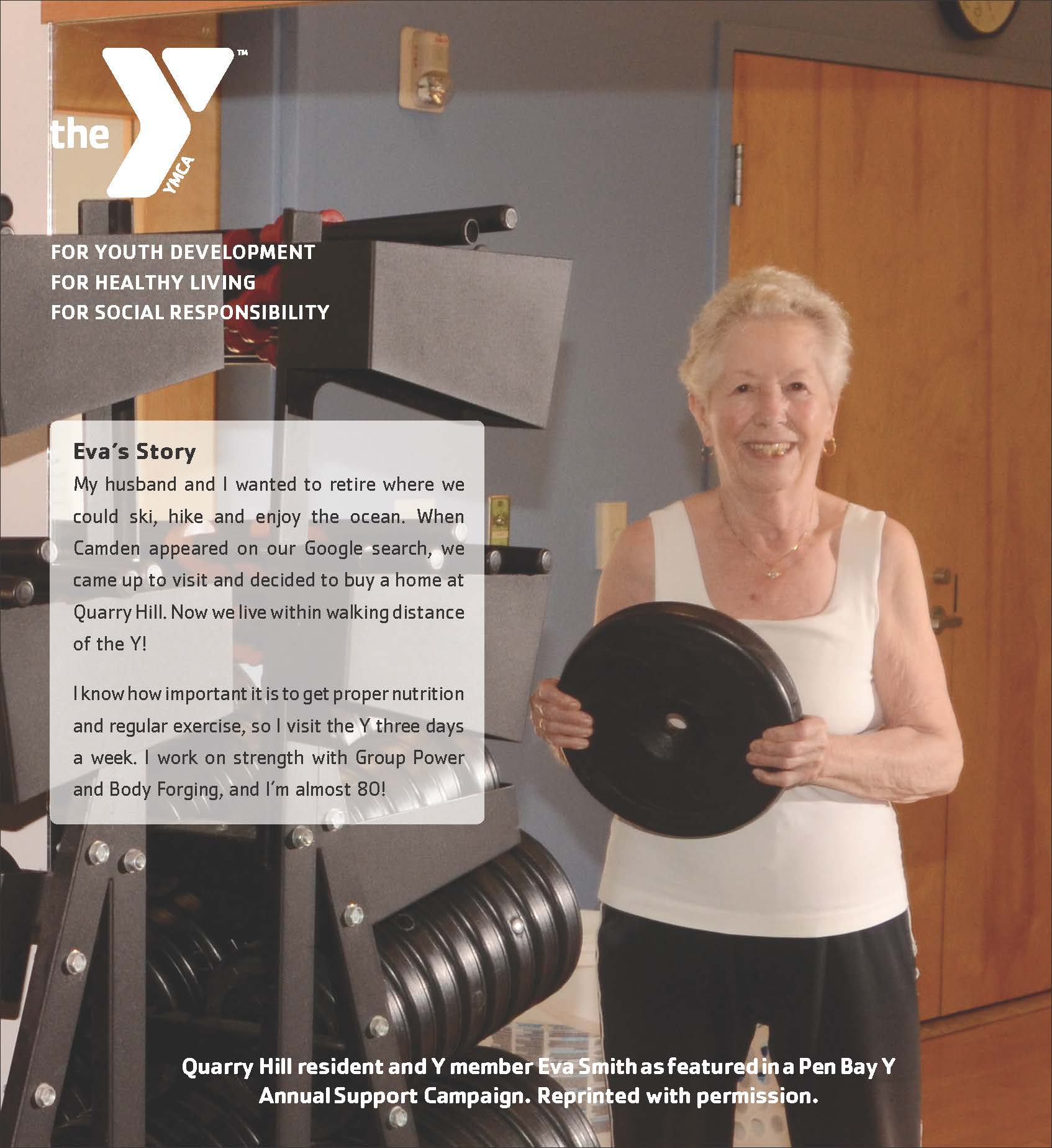
Quarry Hill resident Eva Smith never set out to be a “poster child” for active senior living. But when the Midcoast’s outstanding Pen Bay YMCA went looking for the perfect spokesperson for the its annual fundraising campaign, Eva was the obvious choice.
As featured in campaign posters, Eva certainly puts her Y membership to good use, taking part in thrice-weekly fitness classes at the state-of-the-art facility just around the corner from Quarry Hill. She started with the Y’s Silver Sneakers programs for older adults but soon switched to more challenging classes designed for adults of all ages. She’s often the oldest exerciser in the group but says she likes working out with younger people: “They make me work harder!”
Of course, the Y is just part of the healthy, active lifestyle that Eva—and so many like-minded folks in her age group—have found in Midcoast Maine. From the ocean to the lakes to the surrounding mountains, Camden’s stunning natural setting has seniors here sailing, swimming, biking, hiking, and power-walking their way to fitness and loving every minute. The Mid-Coast Recreation Center adds skating and tennis to the area’s mix of indoor options, while outdoor recreation areas (two golf courses, Camden Hills State Park, and a downhill and cross-country ski center to name but a few) inspire four-season forays into the rugged beauty and fresh salt air for which the coast of Maine is renowned.
For Quarry Hill residents, there’s even more to keep folks moving. Our 26-acre campus, laced with paved walking paths, are a walker’s paradise. Our Fitness Room offers unlimited use of a treadmill, rowing machine, and stationary bikes; and free onsite fitness classes, led by YMCA instructors, promote strength, flexibility, and healthy camaraderie. Heck, in a pinch (or the occasional snowstorm), a person can get a pretty good workout, just walking the halls of the Anderson Inn!
We encourage everyone to follow in Eva’s sneaker-steps and stay well by staying active. For more information about health and wellness programs at Quarry Hill, visit our home page, click on “Lifestyle” and then on “Health and Wellness.” Or, pick up the phone (flex those biceps!) and dial 207-301-6116. We love to talk fitness!
Archives
- June 2022 (1)
- June 2021 (1)
- March 2021 (1)
- December 2019 (1)
- April 2019 (1)
- July 2014 (1)
- June 2014 (1)
- April 2014 (1)
- March 2014 (1)
- January 2014 (1)
- December 2013 (1)
- November 2013 (1)
- October 2013 (1)
- June 2012 (1)
- April 2012 (1)
- March 2012 (1)
- February 2012 (1)
- December 2011 (1)
- November 2011 (2)
- August 2011 (1)
- June 2011 (1)
- May 2011 (1)