Quarry Hill
30 Community Drive • Camden, Maine • 04843 (207) 301-6100 • qhinfo@mainehealth.org
Made in the Shade: Sun Safety for Seniors
Posted on Tuesday June 7
As we get on in years, we might think—with a twinge—that it’s too late for us to realize our youthful dreams of scaling Mount Everest or circumnavigating the globe or performing center stage at the New York Metropolitan Opera. We might also think it’s too late for us to do anything to avoid skin cancer. So why bother trying to protect ourselves from the sun, right?
Wrong. According to the CDC, most cases of skin cancer appear in people over age 65. Cases of melanoma, the most serious type of skin cancer, rise steadily across the life span, peaking amongst 80-to-84-year-olds and declining only slightly from that point on.
Why is skin cancer so prevalent in later life? For one thing, we’re living longer. Today, people who reach the age of 65 can expect to live, on average, two more decades, which gives the damage caused by sunburns in our younger years time to “mature” and surface as skin cancer. Skin gets thinner as we age, allowing ultraviolet rays (UV) to penetrate more deeply. And finally, many seniors take medications—everything from common antibiotics and NSAID pain relievers to antidepressants, diuretics, and blood-pressure and cholesterol meds—that elevate sun sensitivity.
We asked board-certified gerontologist Maureen Sauvage, D.O., supervising physician of Quarry Hill’s inhouse primary care practice what she recommends as a sensible sun safety strategy for her patients. Consider these pointers if the skin you’re in is 65-plus:
1. Make sunscreen a daily habit, like brushing your teeth. Remember that UV rays can damage skin in as little as 15 minutes. So even if you are only running outside to water plants or walking from your car into the grocery store, you need protection. Rays can penetrate both clouds and glass, so don’t assume that you can “go bare” because it’s cloudy or because you’ll be inside a car or even in your house if you’ll be sitting by a sunny window.
2. Choose a sunscreen that’s SPF 15 or more (SPF 30 or more if you’re fair-skinned). A sunscreen’s SPF (sun protection factor) indicates how well it absorbs and reflects the sun’s rays. SPF 30 means the product absorbs 97% of burning rays.
3. Go “broad-spectrum.” Sunscreens labeled as such help shield you from both UVA and UVB rays. UVA rays penetrate the skin’s lower levels and account for 95% of all rays. UVB rays, the underdogs percentage-wise, nonetheless cause more sunburns and sun damage.
4. Play by the clock. Stay indoors or in the shade between 10 am and 4 pm, when UV rays are at their strongest.
5. Use sunscreen correctly. Apply it at least 20 minutes before you head outdoors and reapply at least every two hours. And use plenty—most people underestimate how much they need.
6. Wear protective clothing. Wide-brimmed hats, long-sleeved shirts, long pants, and UV-filtering sun glasses are de rigeur when you’re going to be in the sun for extended periods. You might also want to purchase some of the new hats, shirts, and pants designed to filter UV rays.
So while it may be time to say sayonara to buying a Harley or joining the circus, you’re in the prime of life for exercising sun safety. This summer, go forth (liberally suncreened) and have fun.
Easing Back into Post-Pandemic Life
Posted on Tuesday June 8
Back in April, just as most Americans were getting as giddy as kids in a candy shop over the prospect of a life post-COVID, we stumbled on an interesting article on thelily.com. In it, author Aviva Loeb said that despite the general merriment about once again being able to go out to eat, roam the aisles of grocery stores maskless, and, best of all, visit with friends and loved ones, some folks were experiencing “mixed emotions.”
Indeed, both here at Quarry Hill and amongst our friends and relatives elsewhere, we’ve found that some people are feeling a bit anxious about returning to normal. Some worry they’ve lost the art of casual chit-chat. Others fear it’s too soon to let down our guard. Seniors, particularly those in their 80s and 90s, question whether they have the stamina or even the desire to do what they did pre-pandemic.
Quarry Hill health services coordinator Nina Cunningham, RN, says some of Loeb’s advice for “easing back” into a more outgoing way of life may be especially useful for older adults and those trying to help them adjust.
For starters, Nina counsels elders who’ve been sick with COVID or suffered the loss of someone they love to “give yourself time to process what you’ve been through.” Journaling, walking or spending time outdoors, or talking with a trusted confidante or mental health provider can help bring closure and make it easier to carry on.
If you’re among the legions of introverts who have long appreciated periods of solitude, or if you found you liked the slower pace that resulted from COVID restrictions and cancellations, remember that you can keep whatever aspects of life under COVID you’ve liked. Do try to build some form of social engagement back into your life, because everyone needs at least a little in-person interaction for the sake of mental health. But be choosy. Pick only those activities or contacts you truly enjoy.
Finally, embrace your inner curmudgeon. Even if everyone around you is raving about the experiences they can’t wait to have this summer, it’s okay to take a more conservative approach. Plenty of people are still wearing masks inside grocery stores and saying “no thanks” to wedding invitations. They’re not wrong. In fact, they’re providing a public service by reminding the rest of us of the importance of remaining vigilant, lest current policy relaxations lead to new outbreaks.
We’ll have more on this topic in the next issue of Quarry Hill’s News & Views newsletter. In the meantime, please enjoy “easing back in”—in whatever ways and to whatever extent your comfort level allows.
Building Elders Defenses Against the COVID “Lonelys”
Posted on Thursday March 4
Today’s social scientists and healthcare providers call it social isolation. Older folks call it just plain lonely. But whatever terms you use, spending days or weeks on end with little meaningful interaction with others or with the world outside one’s own four walls has disproportionately afflicted people age 65 and up in our society. And the current pandemic has made a bad situation worse.
Physical distancing guidelines are, of course, essential, especially for seniors. But as the U.S. Centers for Disease Control, the National Institute on Aging, and other organizations have underscored, the resulting isolation significantly increases elders’ risk of everything from depression and anxiety to heart disease, high blood pressure, Alzheimer’s disease and even death.
The good news is, there’s plenty we all can do to help “inoculate” the older people we love against the ravages of chronic loneliness. Experts recommend making sure the senior in your life has at least these three things in place:
Alternative Ways to Socialize
Set them up with the technology they need for virtual visits with family and friends—and, if necessary, show them how to use it. Consider “Zooming” at the same time every week, or just checking in by phone at the same time every day, to give your loved one the added benefit of having something to look forward to. You can also help them find other safe ways to socialize online, like secure chatrooms, private Facebook groups, and internet game clubs.
Physical Activity
Nothing boosts a person’s mood like a little exercise. Encourage Mom or Dad to get outdoors every day, weather permitting, for a walk—even if it’s only to the corner stop sign and back. Help them find an appropriate fitness or stretching class online (YouTube has zillions). Or suggest they get up and dance a few times each day to whatever music they love.
Something to Think About
When it comes to keeping loneliness at bay, an active brain is almost as important as an active body. Mental stimulation can be as straightforward as reading a book or working a puzzle, or more ambitious, like learning a new language online. Explore options that match your family member’s interests, and do your best to get him or her involved.
In short, while it’s true that COVID safety will likely require older folks to practice physical isolation for a while longer, the harmful effects of social isolation can, through a combination of user-friendly tech and old-school creativity, be avoided. For a fuller treatment of this subject, check out the Winter-Spring 2021 edition of Quarry Hill’s News & Views newsletter, coming to subscribers’ mailboxes—and to our website—in April. Or link to the following trusted sources:
Don’t Wait to Join the Waiting List!
Posted on Friday December 6
Suppose you’re 60-something, brimming with good health, and you tell friends you’ve put yourself on the waiting list for an apartment at Quarry Hill. What sort of reaction do you think you’ll get? Concern? Incredulity? Outright laughter?
Whatever the response, rest assured that getting on the waiting list now—five, 10, or even 15 years before you think you might want or need the services of an older-adult community—could turn out to be one of the smartest moves you’ve ever made. To understand why, you need to know how our waiting lists work.
Whenever there’s an opening at Quarry Hill, we first notify our residents. If none of them wants the cottage or apartment in question, we offer it to the people on the waiting list who have indicated that they’re interested in that type of opening. This results in a list of serious applicants. We then proceed to the next step in the process with whichever applicant has been on the waiting list the longest.
For example: In independent living, where the waiting list is called the Priority List, list members are assigned numbers, in ascending chronological order, as they join. The longer you’ve been on the list, the lower your number—and the likelier it will be for you to come out on top of other interested parties when it’s time for you to make your move.
Quarry Hill maintains separate waiting lists for independent living, assisted living (including dementia care), and long-term nursing care. New people join these lists all the time. Within five or 10 years, people who join today will have hard-to-beat numbers—and will likely be thanking their younger selves for having had the foresight to join the waiting list (or put their loved ones on the list) when they did.
For more information, or for a waiting list application, please call the Marketing Office at 207-301-6116.
A Shot of Prevention
Posted on Monday April 15
Back in the day, once you’d made sure your kids got the immunizations the pediatrician recommended, you were done with shots. But in recent years, advances in medical science have ushered in a brave new world of vaccinations, and this time, they’re for grownups.
In fact, older adults now face a bewildering array of inoculations against everything from pneumonia to whooping cough. So we asked Quarry Hill health services coordinator Nina Cunningham, RN, to boil down the latest advice from the Centers for Disease Control and lay out the four key shots most adults age 65+ should get.
Flu Shot
This one’s a no-brainer. People age 65 and older are among those most likely to suffer complications from the flu. So unless your doctor advises against getting the shot, just roll up your sleeve and do it.
Td Booster or Tdap
Most adults should receive Td booster shots every 10 years. Alternatively, if you have or are expecting grandkids, your physician may suggest the Tdap, which also protects against pertussis (whooping cough), a disease that’s usually mild in adults but can be passed, with potentially serious consequences, to infants and small children.
Shingrix
For most, the new Shingrix vaccine against shingles is well worth the effort. Shingles produces a painful rash that can go on for weeks, and the risk of severe, long-term pain increases with age. Shingrix is highly effective in preventing shingles in older adults—90% compared to 50% to 64% for the earlier Zostavax vaccine. Ask your doctor about it.
Prevnar 13 and Pneumovax
To guard against pneumococcal disease, the CDC recommends that adults 65 and older get two vaccines: Prevnar 13 and Pneumovax. The two formulations protect against different strains of the bacteria that cause pneumococcal disease, so getting both shots maximizes your protection. Why bother? These bugs love to infect older adults, and when they do, the illness and complications thereof can be especially severe. Consult with your physician about how and when to get the two vaccines.
That’s it: just four vaccines, and you’ll have protected your health as conscientiously as you protected your kids’. Now that didn’t hurt a bit, did it?
Retiring from Work, Embracing Life
Posted on Friday July 25
If you happen to be a member of the demographic tsunami known as the Baby Boomer Generation, you’ve probably noticed that (a) you’re suddenly getting a lot of mail from AARP, (b) the “kids” are finally listening to you again, and (c) more and more of your fellow 50- and 60-somethings are pulling up stakes and moving to “retirement” communities.
And by the way, on the subject of retirement communities, here’s another news flash: the term retirement community is headed for, well, retirement. Why? Because these days, the goals and desires propelling people to move to these communities have less to do with retiring from life and more to do with embracing it. Indeed, for many active older adults, moving to a community like, say, Quarry Hill offers distinct advantages over staying put. For instance:
Staying connected
As the years go by, it can sometimes feel as though your world is shrinking. Kids grow up and move away; friends disperse; you hang around the house more and go out less. But in an older-adult community, interesting people and activities are close at hand. You’ll find neighbors out walking and visiting at all times of day. Plus transportation services make it easy to stay connected to the world beyond your own four walls.
Shared caring
What with homes, jobs, and kids of their own, your grown children may not be able to deliver the support you need now, let alone down the road. A community dedicated to the needs of older adults has professionals ready to provide whatever care you might need. So it’s unlikely you’ll ever have to lean on sons or daughters for support.
Chore-free living
Few of us want to spend our golden years mowing grass and shoveling snow. Older-adult communities tackle these and many other household chores for you, so you have more time for fun.
A healthier life
Studies suggest that people who move to older-adult communities live longer and healthier than those who “age in place.” On-site access to fitness options—free exercise classes, walking trails, health-education seminars, etc.—is one reason. Housing that’s specially designed around the needs of older adults is a close second.
So next time you find yourself wondering where all your fellow Boomers have gone, check a few 55-plus communities in your neck of the woods. Or call Quarry Hill. You just might be tempted to move here yourself.
To Haiti, with Love
Posted on Friday June 13

Chelsea LaBree, RN, cares for a patient at a clinic in Jolivert, Haiti.
Working with older adults at the Gardens, Quarry Hill’s nursing care center, Chelsea LaBree, RN, shows a level of self-confidence you might not expect in one who graduated from nursing school only two years ago. But then, she’s already had a level of experience that few nurses her age can match.
Chelsea recently returned from an eight-day total immersion in the nitty-gritty of third-world healthcare. Back in March, she used the clinical skills she’d gained through an internship at Pen Bay Medical Center and on the night shift at Quarry Hill to join a nine-member team of doctors and nurses in a Project Starfish mission to Haiti, where some of the most impoverished communities in the world are still struggling to overcome the effects of a devastating 2010 earthquake.
Operating a clinic in the mountain village of Jolivert, Chelsea and her colleagues worked alongside Haitian medics, providing hands-on care for everything from minor abrasions to more significant illnesses and injuries. She estimates the team treated about 600 patients, infants to old folks, with issues ranging from arthritis to high blood pressure to typhoid and malaria, which are common in Haiti.
Team members also brought desperately needed over-the-counter medications, as well as toys, kids’ clothing, and school supplies for an orphanage in Port au Prince. To meet her assigned quota of 100 pounds of donated goods, Chelsea held a fundraiser at her dad’s Rockland Laundromat; she also received donations from her fellow employees at Quarry Hill and from Kennebec Pharmacy and other local businesses.
Now back on the job at Quarry Hill, Chelsea reflects: “When I left, I didn’t know what to expect. But the assessment skills, the resourcefulness, and the good judgment that I’ve gained in my work here served me well.”
Volunteers Rule!
Posted on Friday April 18
People often ask whether there’s a place for volunteers at Quarry Hill, and if so, what volunteer jobs are available. The answers are (1) YES, and (2) LOTS! And with study after study pointing to the long-term health benefits of volunteering—everything from improved mental sharpness to better physical health–evidence is mounting that just by lending a hand, you’ll help yourself as much as you do others.
To get you started, we offer here just a few of the many, many ways volunteers make a difference every day at Quarry Hill:
Assisting with Special Events
Dinners
Decorations
Holiday Activities
Visiting with Our Residents
Reading Aloud
Playing Cards or Other Games
Helping with Letter Writing of Email
Surfing the Internet
Playing a Musical Instrument
Bringing in Pets
Going for Walks
Distributing Books or Magazines
Just Chatting
Helping with Group Activities
Beano
Social Events
Entertaining (do you play a musical instrument? Dance? Act?)
Cooking
Slide Shows
Craft Projects
Helping with Clerical/Office Tasks
Working in Our Gift Shop
Maybe you see something that appeals to you. Or maybe you have another idea you’d like to discuss? Either way, we’d love to hear from you. Please call volunteer coordinator Noreen Clark at 207-301-6250.
Contemplating a Cottage? “Spring” to Quarry Hill!
Posted on Tuesday March 11
Done with winter? Ready for greener pastures? Yeah, we thought so. Which is why we think you may be pleased to hear that Quarry Hill has extended into 2014 its popular “Cottage Cash” incentive, for those interested in purchasing one of our cottage-style homes. But you’ll want to act fast: the extension will continue for only a limited period and is subject to expiration at any time.
Under the terms of the incentive, prospective new residents who sign an agreement to purchase a cottage can receive up to $5,000 with which to customize the home, or reimbursement of up to $5,000 in documented moving expenses.
Quarry Hill residents who have already taken advantage of Cottage Cash say they’ve used the offer to put a personal stamp on the homes they purchased.
“For our cottage, we had the choice of either carpet or a wood floor. The $5,000 made it easy to decide. Today we enjoy a beautiful maple floor,” says resident Art Zur Muhlen.
Cottage owner Rita Elliott comments: “When I purchased my cottage in 2012, the $5,000 bonus was surely a boon. I used it to purchase the kitchen appliances I wanted and to have a custom entertainment center built in my living room.”
So if you’re age 55-plus and interested in making the move to easy, one-floor, maintenance-free living, now might just be the golden opportunity you’ve been waiting for. To learn more about Quarry Hill, the Cottage Cash program, or cottages currently available for purchase, call 301-6116, or visit http://quarryhill.org/independent-living/cottage-homes or www.facebook.com/QuarryHillCamdenMaine.
Living the Active Life
Posted on Friday January 24
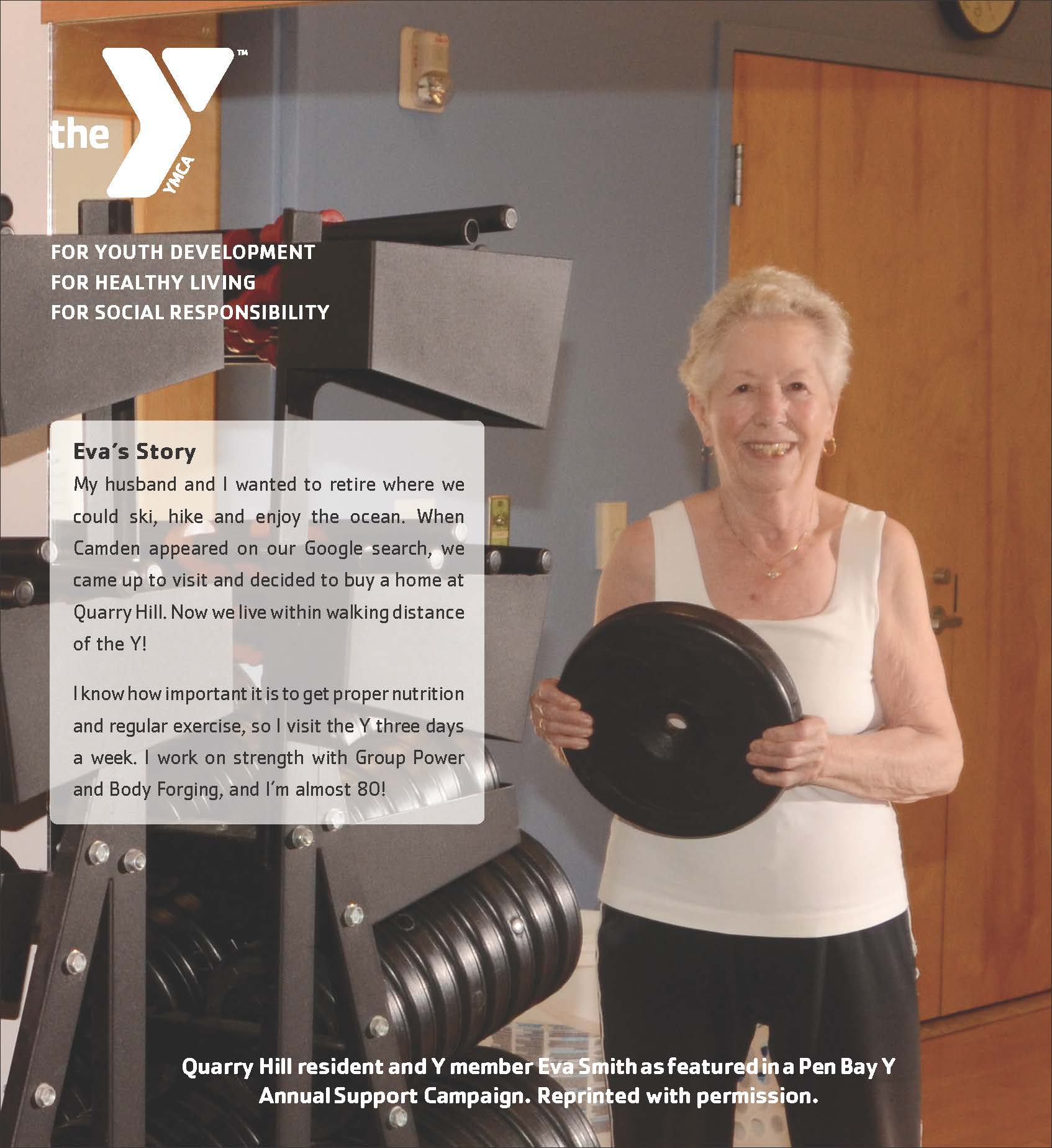
Quarry Hill resident Eva Smith never set out to be a “poster child” for active senior living. But when the Midcoast’s outstanding Pen Bay YMCA went looking for the perfect spokesperson for the its annual fundraising campaign, Eva was the obvious choice.
As featured in campaign posters, Eva certainly puts her Y membership to good use, taking part in thrice-weekly fitness classes at the state-of-the-art facility just around the corner from Quarry Hill. She started with the Y’s Silver Sneakers programs for older adults but soon switched to more challenging classes designed for adults of all ages. She’s often the oldest exerciser in the group but says she likes working out with younger people: “They make me work harder!”
Of course, the Y is just part of the healthy, active lifestyle that Eva—and so many like-minded folks in her age group—have found in Midcoast Maine. From the ocean to the lakes to the surrounding mountains, Camden’s stunning natural setting has seniors here sailing, swimming, biking, hiking, and power-walking their way to fitness and loving every minute. The Mid-Coast Recreation Center adds skating and tennis to the area’s mix of indoor options, while outdoor recreation areas (two golf courses, Camden Hills State Park, and a downhill and cross-country ski center to name but a few) inspire four-season forays into the rugged beauty and fresh salt air for which the coast of Maine is renowned.
For Quarry Hill residents, there’s even more to keep folks moving. Our 26-acre campus, laced with paved walking paths, are a walker’s paradise. Our Fitness Room offers unlimited use of a treadmill, rowing machine, and stationary bikes; and free onsite fitness classes, led by YMCA instructors, promote strength, flexibility, and healthy camaraderie. Heck, in a pinch (or the occasional snowstorm), a person can get a pretty good workout, just walking the halls of the Anderson Inn!
We encourage everyone to follow in Eva’s sneaker-steps and stay well by staying active. For more information about health and wellness programs at Quarry Hill, visit our home page, click on “Lifestyle” and then on “Health and Wellness.” Or, pick up the phone (flex those biceps!) and dial 207-301-6116. We love to talk fitness!
Happy, Healthy New Year!
Posted on Monday December 30
Your muscles ache, your throat burns…Have you come down with the flu? Or just a nasty cold? And why should you care, so long as it goes away?
At Quarry Hill, we know that getting a fix on which bug is to blame for the misery you’re in can have important ramifications—for your health, to be sure, but also for the health of those around you. If what you have is a cold, a few days’ TLC may be all you need. But flu is a bug of a different color. It can lead to hospitalization and even death, so experts advise a more aggressive approach.
Telling the difference between colds and flu can be confusing, as certain symptoms—like headache, weakness, coughing, and sneezing—can occur in both illnesses. In general, though, flu is more severe and is distinguished by sudden onset of fever, muscle aches, chills, and extreme fatigue. Whereas with a cold, symptoms are typically milder, build more gradually, and revolve primarily around sore throat, runny nose, and congestion. (For further guidance, presented in easy-to-grasp chart form, check out www.webmd.com/cold-and-flu/is-it-a-cold-or-flu.)
In the meantime, there’s plenty we can all do to keep colds and flu at bay:
* Wash hands thoroughly and frequently
* Keep hands away from eyes, nose, and mouth
* Get enough sleep, exercise, good nutrition, and water
* Get an annual flu vaccine
So please, take care. All of us at Quarry Hill are wishing you a happy—and healthy—new year.
Thankful for Our Residents
Posted on Friday November 15
Like Americans everywhere, we’re thankful this holiday season to have food on our table, a roof over our heads, and clothes (especially the down-filled, fleece-lined kind) on our backs. But at Quarry Hill, we have another, special blessing to count. It’s the privilege of knowing and serving some of the most interesting people you could ever hope to meet—our residents.
Take Sallie Leighton, for example. Driven by a rambunctious intellect—her “monkey mind,” she calls it—Sallie worked as an airline stewardess and a master gardener. In time, she became a scientist at the New England Institute for Medical Research, where she played a role in isolating co-enzyme Q, an anti-cancer compound now commonly used in skin-care products. These days, books, music, and liberal doses of Senior College keep her multitrack mind humming.
Consider Deane and Ginny Hutchins. For several years beginning in 1966, the couple and their four young daughters lived in Nigeria, where Deane, an epidemiologist for the Centers for Disease Control, helped spearhead a multinational campaign dedicated to vaccinating people against smallpox. By 1968, Dr. Hutchins’ team had vaccinated a remarkable 14.5 million people—an accomplishment that soon led to the elimination of the dread disease, not just in Africa but worldwide.
And then there’s Lydia “The Unstoppable” Lyman. At least that’s how we think of this no-nonsense dynamo who began her adult life as an Isadora Duncan–inspired dancer. One thing led to another (as has tended to happen in Lydia’s freeform existence), and she became field director for the Massachusetts Protestant Guild for the Blind. Eventually, she wound up on Mount Desert Island, of the coast of Maine, where she took possession of her family’s huge, 10-bedroom summer “cottage” and filled it with friends and relatives. (Oh, and she also launched a small grocery store and built four rental properties.)
Chaotic? “Lord love seven ducks, yes!” admits Lydia. “But it was fun.”
And how fun and inspirational it is for us to hear such stories and to know such people.
For that above all things, we give thanks.
Onward!
Posted on Wednesday October 2
We’ve just wrapped up a year-long celebration of Quarry Hill’s 10th anniversary— and what a meaningful year it was!
From the opening outdoor barbecue in June 2012 to the indoor Beach Party in early 2013, the year’s events, centered on a theme of “Building Community,” gave us ample opportunity to reflect on strengths gained during our first decade as one of Maine’s premier senior-living communities. We’re financially strong. And we’re blessed with amazing friends—individuals like you, as well as numerous organizations that share our commitment to older adults.
Even more significantly, the people who know us best—our residents and their families—say they love us. In a survey conducted in 2012 by the independent research company My InnerView, a resounding 100 percent of participating independent-living and long-term-care residents described their overall satisfaction with Quarry Hill as “excellent” or “good” and indicated that they would recommend our community to others. Fully 95 percent of those who received short-term nursing care at Quarry Hill answered “excellent” or “good” to the same questions, and surveys completed by residents of our traditional assisted living community yielded similar results.
The value of these and other assets becomes clearer by the day as we begin our second decade. Already we’re making confident strides in the face of challenges surrounding…
MaineCare
Potential cutbacks in MaineCare—the Medicaid program on which a substantial percentage of our assisted living and nursing care residents relies—may limit both eligibility and coverage. We’re closely monitoring developments in Augusta while using our membership in the Maine Healthcare Association to help influence policy makers.
Residents’ Expectations
Today’s older adults want senior-living communities that offer flexibility, modern technologies, convenience, and choice. We’re saying yes to rising expectations by embellishing our apartments; helping cottage purchasers realize their design dreams; and installing new technologies, like wireless Internet access, throughout the Anderson Inn.
Healthcare Delivery
The new Affordable Care Act has major implications for Quarry Hill and its parent organization, Pen Bay Healthcare. Together, we’re working to adapt to the changes ahead while continuing to improve quality of care.
We hope you’ll continue to follow us as we navigate these and other shifts in the senior-living landscape. Because if there’s one thing we’ve learned, it’s that birthdays aren’t just about where you’ve been. They’re about where you’re headed—and the friends who help you get there.
Ready, Set, Sell Your Home!
Posted on Tuesday June 5
Tempted by Quarry Hill’s new “Cherry on Top” cash incentives to finally purchase that maintenance-free cottage you’ve been waiting for—but worried you won’t be able to sell your existing home? Well, don’t let the doomsayers get you down: You can sell your home in today’s market. And you don’t have to lose your shirt –or your sanity—in the process.
Senior real estate specialist Nicole Bland, ABR©, SRES©, recommends dividing the process into five doable steps.
1. Pricing. Consult your broker for an objective assessment of your home’s market value. He or she will consider the home’s dimensions, layout, lot size, and condition; identify key selling features; and factor in curb appeal.
2. “Staging.” That’s real-estate lingo for sprucing up your home to appeal to prospective buyers. It might mean giving the place a thorough cleaning, fixing a leaky faucet, or just corralling clutter to create a cleaner, airier look. Outdoors, you’ll want to clean up the yard, keep the grass mowed, and remedy any obvious issues like flaking paint or sagging gutters.
3. Showing the property. Often, it’s best to let your broker handle the job of showing the house to prospective buyers. Let the broker know if you’d prefer showings during specific hours or if you’d like him or her to be present when other agents show the home. Holding an open house? Be sure to place valuables and prescription meds out of sight.
4. Negotiating the sale. Once you have an offer (hooray!), your broker can help you decide whether it’s reasonable and help guide you through the negotiations. Discuss the offer with your grown children, siblings, and anyone else with a stake—emotional, financial, or otherwise—in the deal. Before you accept an offer, and certainly before closing, remember to have an attorney review all documents and contracts.
Step 5? Break out the champagne; raise a toast to a new, more carefree life; and then check out the beautiful cottage homes waiting for you at Quarry Hill.
Adventures in Cyberspace
Posted on Tuesday April 10
If you’re online—and obviously, you are—then you’re already part of what is surely one of the most dramatic cultural shifts the world has ever known. It’s the electronic revolution. And in the space of just a few decades, it has fundamentally changed the way people seek and share information and ideas.
Here at Quarry Hill, we’ve come a long way from our original website, launched back in what now seems, in electronic terms, like Paleozoic era (2001? 2002?). Today we’re using “new media” to reach more people than ever before—and make it easier for them to reach us. In 2008, we gave the website an overhaul, making it cleaner, brighter, easier to navigate, and more interactive. And just last year, we launched two new adventures in cyberspace: the blog series you’re now reading, offering news and perspectives on the joys and challenges of older adulthood; and a page on Facebook, where we post coming events, images, info on the recent staff and resident doings, apartment and cottage availability, and all sorts of tidbits of interest to older adults and their families (we already have 117 “friends” and counting!).
All of this has made it easier for people to get information about Quarry Hill. But for us, perhaps the best thing about these new electronic communication tools is the dialogue it allows us to have with you—our residents and families as well as those considering their retirement and healthcare options. Every day, through the web and via Facebook, you write to us—and great relationships result.
Let’s keep the conversation going. Make it a habit to check in with us here at www.quarryhill.org. Or become the 118th (or so) person to “like” us at www.facebook.com/quarryhillcamdenmaine.
With Collaboration, Falls Drop
Posted on Friday March 2
One of the most pleasant surprises to emerge thus far from Pen Bay Healthcare’s membership in MaineHealth has been the opportunity to work with other member organizations on preventing falls and fall-related injuries among seniors.
Falls are no joke. According to the Centers for Disease Control and Prevention, they’re the leading cause of injury-related death in adults age 65 and older. Twenty to 30 percent of seniors who fall suffer moderate to severe injuries such as lacerations, hip fractures, or head trauma, making it difficult for many of these folks to continue living independently. And the cost? A whopping $19 billion, as estimated in 2000 by the CDC.
Spurred by the grim statistics, clinicians at Quarry Hill’s Gardens nursing-care center began working closely with their counterparts throughout MaineHealth in 2009 to reduce the incidence of falls in nursing-care centers system-wide. Their efforts are paying off. Injurious falls have declined from an average of 5.42 per thousand bed days of care in the first quarter of 2009 to just 1.06 per thousand bed days in the third quarter of 2011.
Gardens manager Carmen Edwards, RN, credits a two-part strategy, developed by the workgroup, for the healthy trend. The first part calls for nurses and other caregivers to evaluate and monitor any individual who falls, investigate and record the circumstances surrounding the fall, alert our onsite physician or other attending physician, and take steps to prevent future incidents. In the second phase, caregivers complete a full assessment of the individual’s risk of falling, devise a preventive plan of care, and monitor results.
Now, workgroup members are spreading the gospel, training additional clinicians to use the strategies they’ve devised and aiming to make nursing-care communities throughout the MaineHealth network even safer for the people they serve.
It just goes to show what a little teamwork can do.
Mainecare Update
Posted on Wednesday February 1
By now, you’ve probably heard about Maine Governor Paul LePage’s proposal to plug a hole in the state’s budget by reducing or eliminating a number of services now funded by Mainecare, the state’s Medicaid program. In December, we asked our residents, friends, and everyone who cares about the well-being of older adults throughout Maine to join us in urging legislators to reject the governor’s proposal. We’re delighted to report that people everywhere answered the call—and our elected representatives got the message, loud and clear.
Here’s why it’s so important to protect MaineCare support for low-income elders: Currently, some 4,000 low-income seniors, including many of Quarry Hill’s current residents, rely on Mainecare to pay for assisted-living care. These folks don’t need nursing homes, but their needs are such that they cannot live at home. Many were not poor or low-income when they entered assisted living; however, by paying for the care they require, they have gradually “spent down” their resources to a point where they can no longer afford the cost of care. If we deny Mainecare support to these fragile seniors, we’ll have solved an accounting problem but abandoned some of our most vulnerable neighbors.
Today, thanks to the many who have told legislators not to balance the budget on the backs of Maine’s low-income elderly and disabled, we’re cautiously optimistic that the proposed Mainecare funding cuts will be denied. The Appropriations and Financial Affairs Committee and the Health and Human Services Committee, charged with reviewing the proposal, have said that they’re committed to finding an alternative to the governor’s plan. But the underlying budget issues remain unresolved.
We’re grateful to all who have joined us so far in the fight to protect funding for assisted-living care. Rest assured: we’re keeping a watchful eye on developments in Augusta and will keep you posted as this important issue evolves.
Chill, Baby!
Posted on Friday December 30
Here at Quarry Hill, it’s our business to create a stress-free lifestyle for the residents we serve. But let’s face it: life is stressful. And never more so, in our opinion, than in January, what with post-holiday credit-card bills, slippery roads, and cars that won’t start. So we’ve been especially grateful for the following advice on stress management, courtesy of Rockport-based Reiki master (and former Quarry Hill nurse) Pauline Wilder, RN, MSN, AHN-BC.
Be still
Try setting aside time to simply be. Rather than jumping out of bed in the morning, give yourself five to 20 minutes of “quiet time.” Lie awake, or sit on the edge of your bed, feet on the floor, hands in your lap. Breathe slowly and deeply. When thoughts arise, accept them, and observe how they make you feel. Repeat daily, without fail. In time, a calmer, healthier, more serene you will emerge.
Name your pain
When stress escalates, most of us shift into denial. But suppressing our anxieties only leads to more trouble—what Wilder calls the “snowballing physical effects” of muscle tension, increased heart rate, diminished immune-system functioning, and more. Instead, she says, it’s far better to face your fears. List concrete steps you can take to deal with the problem. Ask yourself whose help you might enlist.
Choose peace
Conflicts with others—the rude cab driver, the surly teenager, that blankety-blank store clerk—can put you over the recommended daily allowance for irritation. But while your instinct might be to fight back, Wilder suggests taking the opposite tack. Begin each day with a proactive “forgiveness meditation”: wish peace first to yourself, then to your family, then to everyone on your street, town, nation, world. Later, should conflicts arise, ask yourself: “Would I rather be right? Or would I rather be at peace?”
With tools like these in your pocket, Wilder says, there’s no need to stress over stress management. The keys to a healthier life are in your hands.
New Technologies Enhance Nursing Care at Quarry Hill
Posted on Wednesday November 30
Two years ago, the Gardens, Quarry Hill’s 39-bed short- and long-term nursing care community, became the first center of its kind in Maine to offer patients and residents the services of an on-site senior services physician. Today, the Gardens remains on the leading edge, with the introduction of technologies designed to make patients’ and residents’ day-to-day lives more comfortable, streamline care, and improve outcomes.
Commenting on the developments, Director of Nursing Nancy Marcille, RN, BSHA, points to a range of enhancements that includes new patient lifts and improved diagnostics as well as expanded wireless connectivity to the Internet:
Patient lifts
A new system of portable motors and ceiling tracks helps individuals with mobility challenges get out of bed and navigate hallways more safely and independently. Part of the Safe Patient- and Family-Centered Care initiative underway throughout Quarry Hill’s parent organization Pen Bay Healthcare, the system promotes dignity, speeds recovery, and reduces the risk of injury for patients, residents, and staff. Ultimately, Quarry Hill expects to offer the system in all Gardens rooms.
On-site diagnostics
Diagnostic equipment newly installed at Quarry Hill has meant fewer unnecessary trips to the hospital.
For example, EKGs, which measure electrical impulses in the heart, can now be performed at the Gardens under physicians’ orders, thus eliminating a hospital visit. What’s more, the results often allow doctors to rule out conditions that would require a lengthier inpatient stay.
Another new tool, the ultrasound bladder scanner, allows specially trained nurses to measure the amount of urine in a person’s bladder and, if necessary, take steps to relieve retention. Retention may lead to urinary tract infections that can be particularly dangerous for frail or elderly patients; and catheterization, previously used to prevent retention, is uncomfortable and can itself lead to infection.
Wireless access
Wireless web access, now available throughout the Gardens, not only enhances patients’ and residents’ day-to-day lives, but has surprising therapeutic benefits as well.
“Today, more and more of the people we serve are web-savvy,” says Marcille. “We’ve found that those who stay connected to friends, family, and the larger world tend to be happier and recover more quickly.”
A Doctor in the House
Posted on Tuesday November 1
Only two short years ago, it all felt so novel. Quarry Hill had just become the only community of its kind in Maine to offer residents the services of an inhouse physician, and the mere sight of the snowy-bearded Richard Kahn, MD, striding the halls in his lab coat and stethoscope, had us all doing doubletakes. “Richie” Kahn is now an established and treasured member of our team. But has the Senior Services Physician Specialist (SSPS) model—a homegrown innovation that once, and still, sets Quarry Hill apart in its field—lived up to its original promise? Actually, yes. And then some.
To be sure, more and more residents are feeling the benefits of Dr. Kahn’s care. As of October 2011, his practice had grown to include 74 percent of individuals residing in the Gardens, Quarry Hill’s short- and long-term nursing center; 71 percent of residents of the Terraces, our traditional assisted living program; and 78 percent of those in the memory-impairment community known as the Courtyard. Thirty-seven percent of our independent-living residents use Dr. Kahn as well.
And from what we hear, the vast majority of these folks are highly satisfied with the doctor’s care.
“When I moved to Quarry Hill, I found I liked the convenience of having my own doctor, right here in the building,” comments independent-living resident Emily Mundo. “Dr. Kahn really listens to what I have to say. And because he specializes in the needs of older patients, I feel confident in his care.”
Similarly smitten is Camden resident Ann Montgomery, whose husband resides in the Gardens: “Now that Quarry Hill has a doctor on site, I can’t imagine being without him. Knowing that he’s there and able to take care of any problems that arise is a tremendous comfort to me.”
But convenience and peace of mind for those on the receiving end of the SSPS model aren’t the only reasons why people here are singing its praises.
Director of Nursing Nancy Marcille, RNC, BSHA, speaks from a clinical perspective when she raves about the changes that have occurred since the program went into effect.
“In terms of both timeliness and continuity of care,” she says, “there’s simply nothing like having a physician on site. With Dr. Kahn here, we’re addressing medical issues before they become crises. We’re avoiding unnecessary hospitalizations; and we’re catching problems we might otherwise have missed that do warrant a hospital stay.”
Gardens Unit Manager Carmen Edwards, RN, chimes in: “Before, on a typical day, we used to work with as many as 10 different doctors. We had to track them down and then wait for orders and instructions. Now, patient care is much more efficient. Even when Dr. Kahn isn’t here, we can always reach him on his cell phone.”
So what once felt like a bold plunge into uncharted territory is paying off. With SSPS, “we’re providing better, safer, more consistent care for all our residents,” summarizes Carmen. “And that’s what Quarry Hill is all about.”
Quarry Hill Goes Green
Posted on Monday August 1
Concern for the environment—both indoors and out—is revolutionizing the way Quarry Hill cares for its buildings and grounds.
Within the Anderson Inn, home to some 170 residents, recycling has become standard procedure. Employees here have been recycling paper, cans, plastics, cardboard boxing, batteries, returnable bottles, and more for years—and encouraging residents to do the same. Environmental concerns are driving everyday cleaning choices, too, with housekeepers using earth-friendly agents for everything from surface cleaning to odor elimination.
Other initiatives seek to minimize Quarry Hill’s energy footprint. Spurred by the results of an audit undertaken about two years ago, the community has continued its transition from incandescent to watt-scrimping compact-flourescent and LED lighting in hallways, lobbies, and common rooms. In some areas, automatic on/off switches have been installed, and insulation has been added to cut fuel consumption.
Outdoors as well, there’s evidence of Quarry Hill’s increasingly “green” ethic. Fewer chemicals on the community’s 26-acre lawnscape means cleaner groundwater and reduced exposure for people, pets, and wildlife. So groundskeepers are using chemicals less, and organic fertilizers more, to keep Quarry Hill’s natural environment green in every sense of the word.
For more information about recycling programs and other “green” initiatives in your area, contact your local town, city, or county government; visit your public library; or try http://earth911.com or www.thedailygreen.com and click on “Get local info.” For tips on reducing your environmental footprint at home and at work, visit www.go-green.com.
Redefining Retirement
Posted on Tuesday June 28
You say you want a revolution? Well, don’t look now, but you may be smack in the middle of one of the largest and most significant paradigm shifts in American history.
The change is in how Americans think about, plan for, and transition into what we once (quaintly) referred to as “the retirement years.” In fact, experts say, the word retirement itself could be on its way to the verbal junkyard, as the nation’s oldest Baby Boomers, now 60-somethings, roar into “old age” in a way that is anything but retiring.
Dr. Lenard Kaye, director of the University of Maine Center on Aging, says these up-and-coming seniors view retirement as “the youth of their old age, not the old age of their youth.” Casting into a future beyond their present workaday lives, they see themselves leaping not into a rocking chair, but a fresh new phase—one that’s more about what “I want” and less about what “I have to.”
And what do they want? Far more, it turns out, than their parents dared dream of. Dr. Kaye says Boomers demand, among other things, access to classes and other learning opportunities, outlets for their hobbies and interests, homes that are comfortable and convenient, and outstanding healthcare. They want emotional and spiritual well being. They want to stay active. They want a continued presence, and a respected voice, in the communities they call home.
Indeed, research suggests, 80 percent of those now 44 to 62 years old say they won’t retire at all but intend to keep working, at least part time. Thirty percent plan to start a business. Legions look forward to launching a second or third career.
How about you? Are you part of the Unretirement Revolution? If so, we think you’ll take to Quarry Hill, and Midcoast Maine in general, like a windjammer to water. Why not come for a visit, and begin planning the next big adventure of your life.
Quarry Hill is on Facebook!
Posted on Friday May 27
Welcome! As technology advances and social media becomes the most popular way to stay connected and find information, we at Quarry Hill want to be sure that our residents, their families and anyone looking for information they will need down the road for themselves or for a loved one is available via multiple avenues. We are thrilled to announce our new blog, and our new Facebook page! Please like us on our Facebook page to stay connected with us!
Quarry Hill, located in the charming seaside village of Camden Maine, offers independent living, assisting liviing, and nursing services.
History & Values
 As you get to know Quarry Hill, you’ll notice something special: We’re not part of some big, faceless corporation. We’re homegrown, locally owned, and managed by people you’ll probably run into at the grocery store.
Our commitment to community goes back to the opening of our predecessor, the Camden Community Hospital (CCH), in 1960. CCH was a true community hospital. Neighbors and summer visitors alike contributed to the building fund-so generously, in fact, that the modern, fully equipped hospital was able to open debt free. In 1976, the town added a 203-bed wing dedicated to providing long- and short-term nursing care plus rehabilitation services. The two facilities became known collectively as the Camden Community Hospital and Health Care Center.
The hospital closed in 1982, following the opening of Penobscot Bay Medical Center in Rockport, but the health care center continued to provide nursing care. In 1996, a task force consisting of members of the community, local government officials, and others began looking for new uses for the old hospital site. The concept of an extended-care retirement community emerged as the best way to serve the area’s healthcare needs; and in 2002, the original hospital and nursing home were taken down, making way for Quarry Hill.
Today, Quarry Hill continues the tradition of caring for the people of Midcoast Maine by providing unsurpassed independent living, assisted living, short- and long-term nursing care and rehabilitation, and specialized memory-loss care. We’re a proud member of Pen Bay Healthcare, committed heart and soul to the well-being of the people we serve.
Our Mission
To provide a full range of living options, high-quality health services, and individualized care plans designed to respect older adults’ varied interests, abilities, and needs and promote independence and well-being.
Archives
- June 2022 (1)
- June 2021 (1)
- March 2021 (1)
- December 2019 (1)
- April 2019 (1)
- July 2014 (1)
- June 2014 (1)
- April 2014 (1)
- March 2014 (1)
- January 2014 (1)
- December 2013 (1)
- November 2013 (1)
- October 2013 (1)
- June 2012 (1)
- April 2012 (1)
- March 2012 (1)
- February 2012 (1)
- December 2011 (1)
- November 2011 (2)
- August 2011 (1)
- June 2011 (1)
- May 2011 (1)